


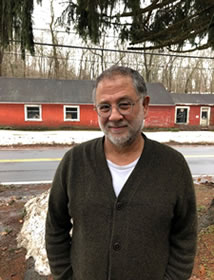

G. Brian Karas was born in September 1957 in Milford, CT. In 1979 he graduated from Paier School of Art in Hamden, CT. From 1979 to 1982 he worked at Hallmark Cards as a greeting card artist in the Humorous Department. He has been a freelance artist since 1982 and has written and illustrated many books which have won numerous awards. He lives in the Hudson Valley of New York.

some Q’s & A’s
Q: When did you start being an artist?
 A: It’s hard to say. I remember that in kindergarten I liked finger painting a lot. And I remember that later on, in third grade, I liked to draw pictures of my favorite comic book and cartoon characters, namely Peanuts and a variety of monsters, and I got pretty good at it. At some point (around the fourth or fifth grade) I realized I could make other kids laugh at my drawings, which I liked. And even though I didn’t sell my drawings I think of that as my first steps on the path to becoming a professional artist. I went on to be the background artist of many a school play and even designed a tile mosaic that was in the front showcase of my elementary school. So I think I became an artist the very first time I opened my eyes.
Q: Where did you learn how to draw?
 A: Art school (Paier School of Art in Hamden CT) followed high school. Suddenly I was with other artists (the entire school!) and I learned not only how to draw and paint but how sharing creative ideas with other artists helped me and my art grow.
I also learned early on that I wanted to be a children’s book illustrator. Several fine children’s book illustrators taught at my school. Personally, I loved to read and this seemed a perfect fit to me. Once that idea took hold I didn’t let go.
Q: Did you start making children’s books right after art school?
 A: It was many years before my first book became published. Hallmark Cards hired me right out of art school. I was an artist (one of many) and worked in the Humorous Cards department. I illustrated hundreds of cards. It was a great education in learning how to draw many different emotions, not just humor. It wasn't picture book publishing like I had hoped but I was making a living at doing what I liked so much – getting people to laugh at my drawings.
Q: When was your first book published?
 A: I left Hallmark after three years and moved to New York to become a freelance illustrator, which I’ve been ever since. At first most of my work was editorial – in magazines and newspapers, for textbooks and (ironically) greeting cards. Throughout this time I continued to work on my picture book portfolio and in 1991 my first illustrated book, THE HOLIDAY HANDWRITING SCHOOL by Robin Pulver, was published.
Q: Do you like your job?
 A: I like it when my work makes people laugh. And cry. And think and feel.
When it makes me laugh, cry, think or feel then I know I have done a good job.
A: I like it when my work makes people laugh. And cry. And think and feel.
When it makes me laugh, cry, think or feel then I know I have done a good job.
Back to Top